
The Budget Review Trap: Why Revenue Partnerships Die in the Accounting Department
Most revenue partnerships are killed not by bad partners, misaligned values, or founder distraction — but by a calendar event that arrives two months before the compound curve. Here is the structural fix.
onSpark Partnership Playbook · 8 min read · For revenue operators and partnership leads
The Partnership Lifecycle
| Phase | Stage | Timeline |
|---|---|---|
| 01 | Discovery | Months 0–2 |
| 02 | Alignment | Months 2–4 |
| 03 | Legal | Months 4–5 |
| 04 | Activation | Months 5–8 |
| 05 | Production | Months 9–12+ |
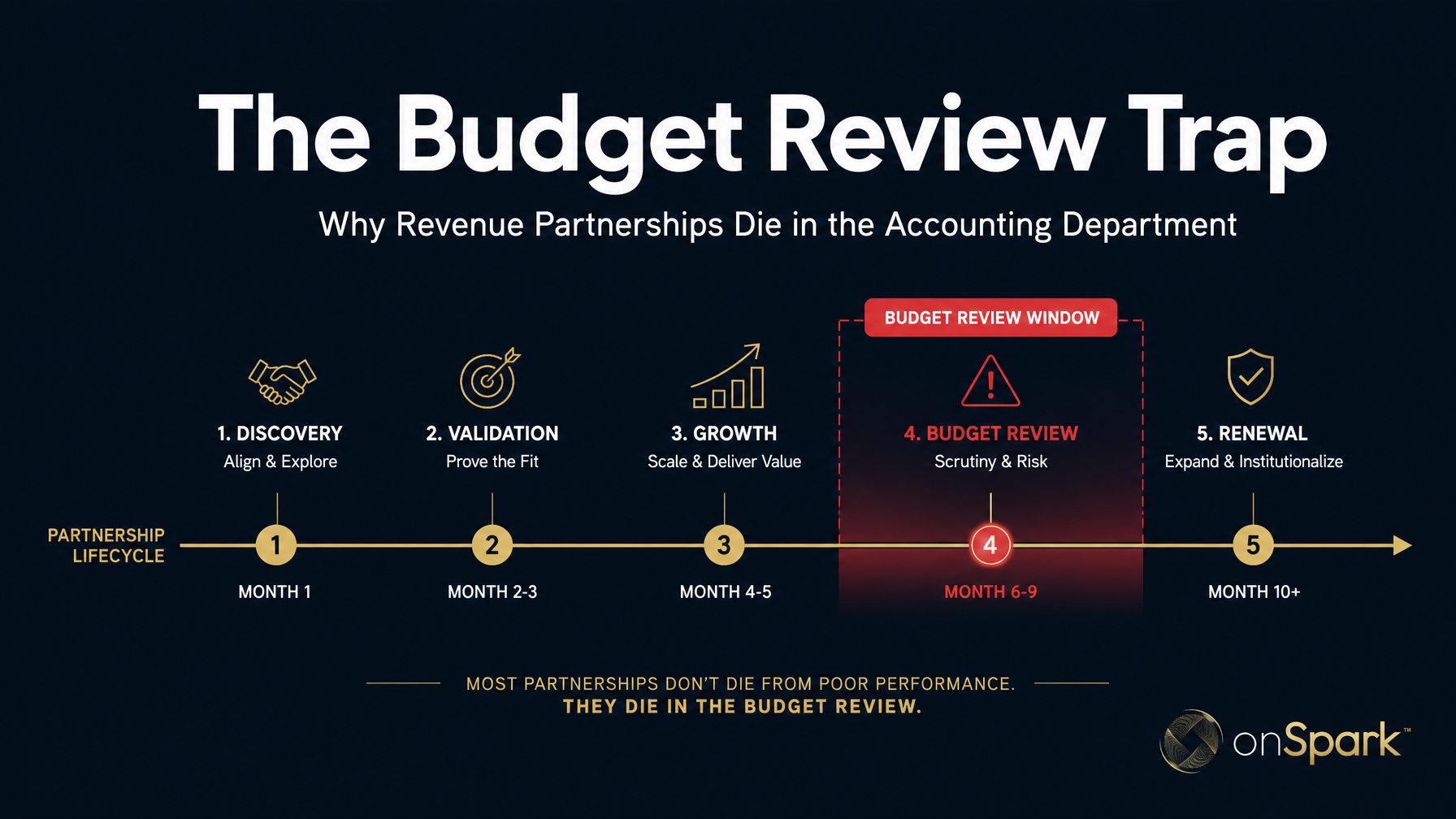
Budget review hits at months 6 to 9. Zero revenue yet, full cost on the books. Without a pre-agreed non-revenue metric, teams get cut before the compound curve kicks in.
When a partnership collapses, the post mortem almost always lands on a person. The founder got distracted. The champion changed jobs. The other side went quiet. That explanation is comfortable because it asks nothing of the operating model that surrounded the deal.
The harder truth is that most partnerships are killed by a calendar event that has very little to do with the partners themselves. Founder psychology gets the blame, while the system that measured the partnership quietly fails a basic lifecycle principle and walks away clean.
This is the budget review trap. It is structural, it is predictable, and in most organizations it has killed more revenue partnerships than every bad actor and misaligned value combined. Understanding it is the difference between a partnership strategy that compounds and one that resets every cycle with new faces and the same outcome.
The Lifecycle Runs on a Fixed Sequence
Every revenue partnership moves through the same five phases, and the order does not bend to anyone's preference.
Discovery comes first. Two teams qualify whether their ideal customers actually overlap and reach a binary verdict on fit. This is not a relationship phase. It is a qualification phase, and it produces a go or no-go before any resource allocation occurs.
Alignment follows. The deal gets designed, activation owners get named, and a joint pipeline goal gets set on paper. This is where the value exchange becomes explicit and where the structural ambiguity that will later become a dispute either gets resolved or gets buried.
Legal sits in the middle and turns the alignment brief into signed terms across one or two redline rounds. It is the phase most teams underestimate for duration and most founders treat as a formality rather than the moment when every informal assumption becomes binding or disappears entirely.
Activation launches the joint go-to-market and seeds the first qualified pipeline. This is the phase where the partnership stops being a document and starts being a motion. The first activation milestone is the most diagnostic signal in the entire lifecycle: if it slips, the reason almost always traces back to something that was left unresolved in alignment.
Production scales that pipeline, automates attribution, and produces the first joint case study that makes the whole thing repeatable. Production is the phase where the compound curve lives. It is also the phase that most partnerships never reach.
Read those phases against a clock and the danger becomes obvious. Discovery through legal consumes roughly the first five months. Activation runs from month five to month eight. Real, attributable revenue tends to arrive around month nine, and it compounds from there.
The Collision Nobody Schedules
Corporate budget reviews run on their own cycle, and that cycle lands squarely between months six and nine. At that exact window, a healthy partnership shows the worst possible picture on a spreadsheet. The full cost of two teams, legal hours, and activation work sits on the books, while the revenue line still reads zero because the deals seeded during activation have not closed yet.
A finance leader scanning that report sees spend with no return. The program gets flagged, frozen, or cut. It disappears two or three months before the compound curve would have made it one of the most efficient channels in the company. The relationship remained healthy, the work stayed on schedule, and the pipeline was real. Yet the measurement window arrived early and judged the program by a number that was never supposed to exist yet.
The partnership did not fail. It was measured against revenue during the only months it was structurally guaranteed to have none.
This is the specific mechanism behind the majority of strategic partnerships that "just didn't work out." The partners were not misaligned. The champion did not lose interest. The deal structure was sound. The program was doing exactly what a healthy partnership does at month seven, which is building qualified pipeline on a known conversion lag. The only thing that failed was the measurement model, and nobody in the post mortem noticed because the measurement model was never on trial.
The System Fails a Basic Lifecycle Principle
Blaming founder psychology is convenient, and it lets the operating model off the hook entirely. The deeper failure is that most companies measure partnerships with the same instrument they use for everything else: a monthly revenue report.
That instrument assumes a roughly linear relationship between spend and return inside a single quarter. Partnerships violate that assumption by design, because they front-load cost and back-load revenue across three to four quarters. When the measurement system cannot see the leading indicators of a working partnership, those indicators do not count. Anything that does not count gets cut first under pressure.
The trap is structural, which is also why the same companies fall into it again and again with new partners and new champions every cycle. The people change. The calendar collision stays exactly the same.
Build the KPI Into the Timeline
The fix is to agree on a non-revenue metric before the partnership starts, and to write that metric into the timeline alongside the revenue projection. The job of that metric is to give the budget review a fair number to judge during the months when revenue is still maturing in the pipeline.
01 — Qualified Pipeline Created
Pipeline sourced through the partnership and converting to revenue on a known lag. If your average sales cycle is ninety days and the partnership seeded forty qualified opportunities in month seven, the month ten revenue projection is not a guess. It is a math problem with a known input.
02 — Activation Milestones on Schedule
Proof the joint motion is operating in market rather than living on a slide. A partnership that hits its activation milestones on time is a partnership that will hit its revenue milestones on the back end of its lag.
03 — Joint Opportunities Accepted
Deals both sales teams have validated, showing the channel actually produces qualified demand rather than traffic. A joint opportunity accepted by both sides is a revenue event with a known probability of close.
04 — First Reference Customer
An early signal that the model will repeat, well before the case study ships. A reference customer sourced through the partnership before month nine demonstrates that the value exchange is real, the co-sell motion works, and the partnership can produce a replicable result.
With those metrics agreed in advance, the month seven budget review reads very differently. Leadership sees spend against a growing pipeline tracking to a known conversion lag, rather than spend against an empty revenue line.
Why Most Partnership Strategies Never Solve This
The reason most organizations cycle through the same trap every two years is not that they lack smart people. It is that the solution requires work that happens before the partnership starts, at exactly the moment when everybody involved is most optimistic and least inclined to stress-test the measurement model.
The founders and revenue operators in onSpark's network who have built durable partnership pipelines are almost universally the ones who treated the measurement conversation as part of the alignment phase, not as an optional administrative step after legal closed.
The Parallel Problem: Partnership Pipeline Gaps
Most organizations enter a strategic partnership with exactly one partner in active development at a time. When that partnership hits the budget review window, the team has no alternative pipeline to point to and no comparative benchmark to contextualize the current program's performance.
A partnership program with three active partnerships in different lifecycle stages reads completely differently at a budget review than a program with one partnership at month seven showing zero revenue. Building partnership pipeline is the prerequisite to surviving budget reviews, not just to finding better partners. That is why onSpark's matching engine is designed to surface three to five qualified partners simultaneously. A single partnership is a calendar risk. A pipeline of partnerships is a revenue strategy.
Where onSpark Comes In
onSpark builds the non-revenue KPI directly into the partnership timeline, so every program carries a defensible metric straight through the dangerous budget window. We map the lifecycle, name the activation owners, and instrument the leading indicators that prove progress long before the first dollar lands.
The Partnership Readiness Score that every onSpark member receives at intake is partly a matching tool and partly a measurement framework. It gives the partnership lead something concrete to report at month seven that is not revenue: a readiness score for each active partner, a pipeline stage, and an activation milestone status that translates directly into a revenue projection on a known lag.
The outcome is a partnership that compounds on schedule instead of one that gets cut at month seven for looking exactly the way the math always promised it would look.
Frequently Asked Questions
What is the budget review trap in partnerships?
The budget review trap is the structural collision between the revenue partnership lifecycle and the corporate budget review calendar. Revenue partnerships front-load cost across the first five months and back-load revenue to month nine and beyond. Budget reviews typically land at months six to nine, precisely the window when a healthy, on-schedule partnership shows zero revenue and full cost.
How long do strategic partnerships take to generate revenue?
A well-structured strategic partnership typically produces attributable revenue at month nine or later, after moving through discovery (months 0–2), alignment (months 2–4), legal (months 4–5), and activation (months 5–8).
What non-revenue metrics should a partnership program track?
The four most reliable leading indicators are: qualified pipeline created through the partnership, activation milestones on schedule, joint opportunities accepted by both sales teams, and first reference customer. Each is trackable from the day legal closes.
Why do the same companies keep losing partnerships at the same stage?
Because the failure is structural, not personal. The calendar collision between the partnership lifecycle and the budget review window is fixed. Until the measurement model changes, the same programs will get cut at the same stage with the same post mortem blaming the same categories of human failure.
How does onSpark prevent the budget review trap?
onSpark builds non-revenue KPIs into the partnership timeline during the alignment phase, before legal closes. Every active partnership in the platform carries a readiness score, an activation milestone status, and a pipeline stage that translates into a revenue projection on a known lag.
The Only Question That Matters at Month Seven
When the budget review lands and the revenue line reads zero, there is one question that determines whether the partnership survives: does the room have a number it was pre-authorized to judge this program by?
If the answer is yes, the partnership survives. The pipeline metric, the activation milestone, the joint opportunities accepted — any one of them gives finance a defensible basis for continued investment. The partnership reaches month nine. The revenue arrives. The compound curve begins.
If the answer is no, the partnership gets cut. Not because it failed, but because the measurement model never gave it a fair standard to meet during the only months when meeting a revenue standard was structurally impossible.
Build the metric before the deal closes. Write it into the timeline. Make sure it survives the budget review without you in the room to defend it. That is the partnership strategy that compounds.
Get your Partnership Readiness Score and see how onSpark instruments your pipeline from day one →