Cold Outreach Is Dead. Here Is What Replaced It.
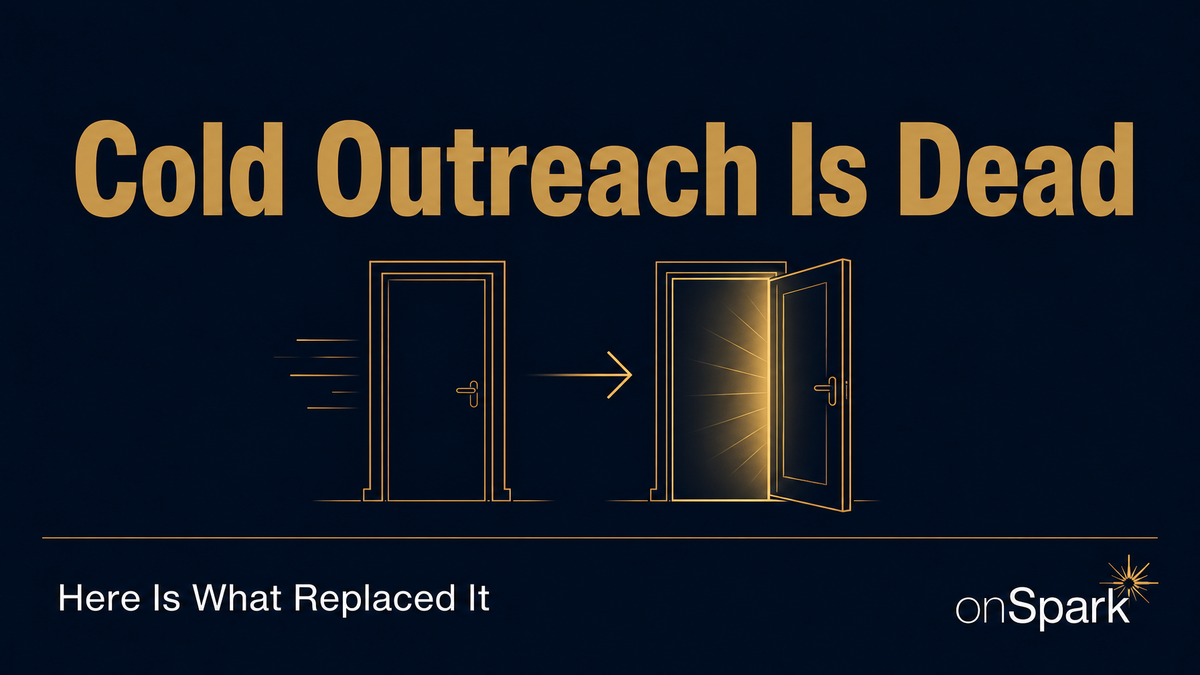
Founders who are still running cold outreach at volume are not failing because of bad copy or weak targeting. They are running a model that stopped working several years ago in a market that has fully adapted to it, and optimizing the execution of a broken model produces the same result regardless of how disciplined the optimization becomes.
The model made sense in a specific window that has now closed. Inboxes were less crowded. Buyers had not yet built the pattern recognition that now filters cold messages before the second sentence. The volume of unsolicited contact had not yet trained professionals to delete by default and occasionally regret it later. None of those conditions apply anymore, and the gap between effort and conversion on cold outreach campaigns has widened every year since.
The LinkedIn post that goes viral and converts nobody is the same problem at a different scale. A founder publishes something that takes off, thousands of likes, hundreds of comments, a follower spike that looks meaningful in a dashboard, and then follows up with every commenter, sends thoughtful connection requests, and opens conversations about potential collaboration with genuine enthusiasm. Two weeks later the pipeline is exactly where it was before the post ran. The attention was real, and it produced no qualified demand.
This pattern has a structural cause. Attention from an audience that does not have a specific problem you solve, a defined budget to address it, and an existing reason to trust you specifically is visibility data, and visibility data does not compound into pipeline without a conversion mechanism sitting underneath it.
The O.P.A. Framework is what replaced it: Offer, Positioning, Access.
Offer is where most founders start last and should start first. Before any distribution strategy can work, the offer has to be positioned for a specific audience with a specific problem, articulated clearly enough that the right person recognizes themselves in the first sentence without qualification language or context-setting. A broad offer requires an enormous audience to surface a small number of qualified responses. A sharp offer delivered through a trusted channel to the right audience converts at a rate that cold volume cannot approach.
Positioning is about being credibly present in the conversations your target audience is already having, in the specific publications they read, the communities they trust, and the partnerships they respect, so that when they encounter your work, the credibility is borrowed from the context rather than built from scratch in the course of a cold message. A founder featured in a publication that their ICP reads every week arrives at a different starting point than a founder who appeared in that same person's cold outreach queue.
Access is the mechanism that makes the model scale. The O.P.A. Framework prioritizes access to existing audiences through strategic partnerships with operators who have already built the trust you are working to earn, so that introductions come warm and conversion happens at fundamentally different rates than anything cold volume produces. When a trusted voice in your target market introduces you to their audience, a portion of their credibility comes with the introduction.
The compounding effect of this model is what cold outreach structurally cannot produce. Cold outreach delivers linear outputs: a given volume of messages produces a predictable conversion rate, and maintaining the pipeline requires maintaining the volume indefinitely. Partnership-driven acquisition compounds. Every partnership that generates results produces proof, credibility, and introductions that make the next partnership easier to initiate and close.
The founders building the largest distribution advantages right now are not sending more messages. They are building fewer, higher-quality partner relationships through a structured process, and accumulating the compounding returns of a model that improves over time rather than one that requires constant input to sustain constant output.