Strategic Partnerships for Founders: The Four-Stage Framework That Actually Works
The founder who built the most productive partnership pipeline this year almost certainly did not have the largest network in the room. They had the most consistent process for converting their existing connections into structured, revenue-generating agreements, and that process is what produced the outcomes.
A 2026 PwC survey found that 72 percent of executives rely on informal networks to identify strategic partners. Harvard Business Review reported the same year that nearly half of all strategic partnerships fail to meet expectations. These numbers belong together, because informal identification produces connections that feel promising and partnerships that stall, and the founders experiencing the most partnership frustration are often the ones with the most impressive networks and the least structured methodology for working them.
The introduction that gets technically made and practically goes nowhere is the most common partnership failure mode that no one talks about. Two operators connect. A mutual contact sends a warm email. Both parties respond enthusiastically, have a call, agree the timing is right, and then return to their respective inboxes and never follow up in any meaningful way. The introduction succeeded. The process that should have followed it did not exist.
Most partnership conversations stall at the relationship stage because there is no defined methodology for moving from an excellent initial conversation to a signed agreement that generates revenue. The excitement of a first call is real and temporary, and without a clear structure driving what comes next, that excitement dissipates before it becomes anything actionable. Founders who understand this do not wait for the natural momentum of a good relationship to advance their deals. They drive the process themselves from the first point of contact, with a clear map of every subsequent step.
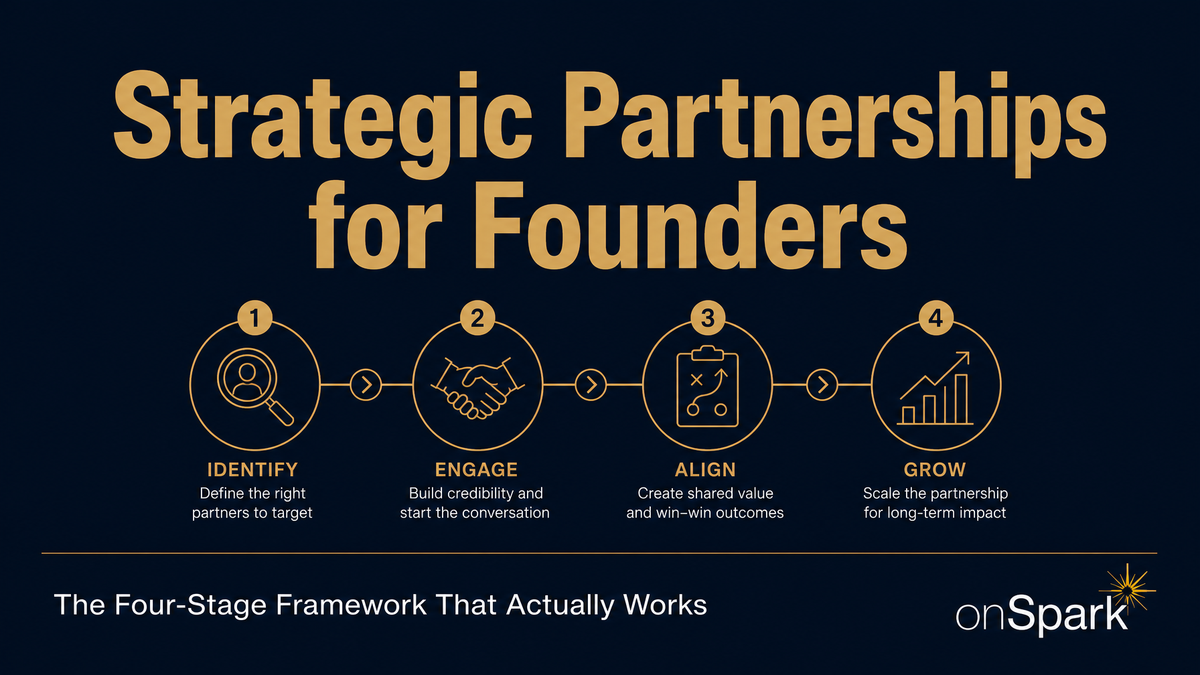
At onSpark, partnership development follows four sequential stages: Discover, Verify, Launch, and Amplify.
Discover is the stage most founders skip or collapse into general outreach. The goal is to identify potential partners who demonstrate genuine strategic fit before any partnership conversation begins, which means evaluating audience overlap, offer compatibility, and growth stage alignment in advance of outreach. Founders who bypass this stage build pipelines full of conversations that were never going to convert, because the fundamental fit was never there to begin with.
Verify tests the initial read against actual evidence. This stage examines a potential partner's previous track record, communication patterns, and alignment between what they have stated about their business and what the data supports. Trust and fit are evaluated using specific criteria rather than the impressions formed in an introductory call where both parties are presenting their best version. Most partnership disappointments trace back to a verification stage that was shortened or skipped entirely because the first call felt too promising to slow down.
Launch defines the terms of the initial collaboration with enough specificity to create real accountability. A shared vision for what the partnership could become is a starting point, not a launch. Defined deliverables, clear timelines, and mutual accountability mechanisms that both parties agreed to in advance are what separate partnerships that build momentum from ones that generate friction from the first week.
Amplify systematically scales what is already working. When a partnership is producing results, the founders who benefit most are the ones who identify the specific mechanisms driving those results and deliberately expand them into adjacent audience segments, additional offer structures, or deeper operational integration. The partnership becomes a durable revenue channel rather than a single successful campaign.
The compounding effect of this approach is what separates it from a network-first strategy. Cold outreach and informal networking produce linear outputs. Partnership-driven acquisition compounds. Every partnership that succeeds through structured execution produces proof, credibility, and introductions that make the next partnership easier to initiate and close, and the cumulative effect of eighteen months of building a structured pipeline is a distribution infrastructure that operates on entirely different mechanics than a contact list worked without a methodology.
The founders who started building that infrastructure a year ago have a structural advantage today that grows with every passing quarter. The market for structured partnership development is still early, most participants are still operating informally, and the gap between what structured execution produces and what informal networking produces is wide enough that the founders who act on it now will still be compounding that advantage years from now.