
The 9 Types of Business Partnerships (And Why You Are Only Using Two)
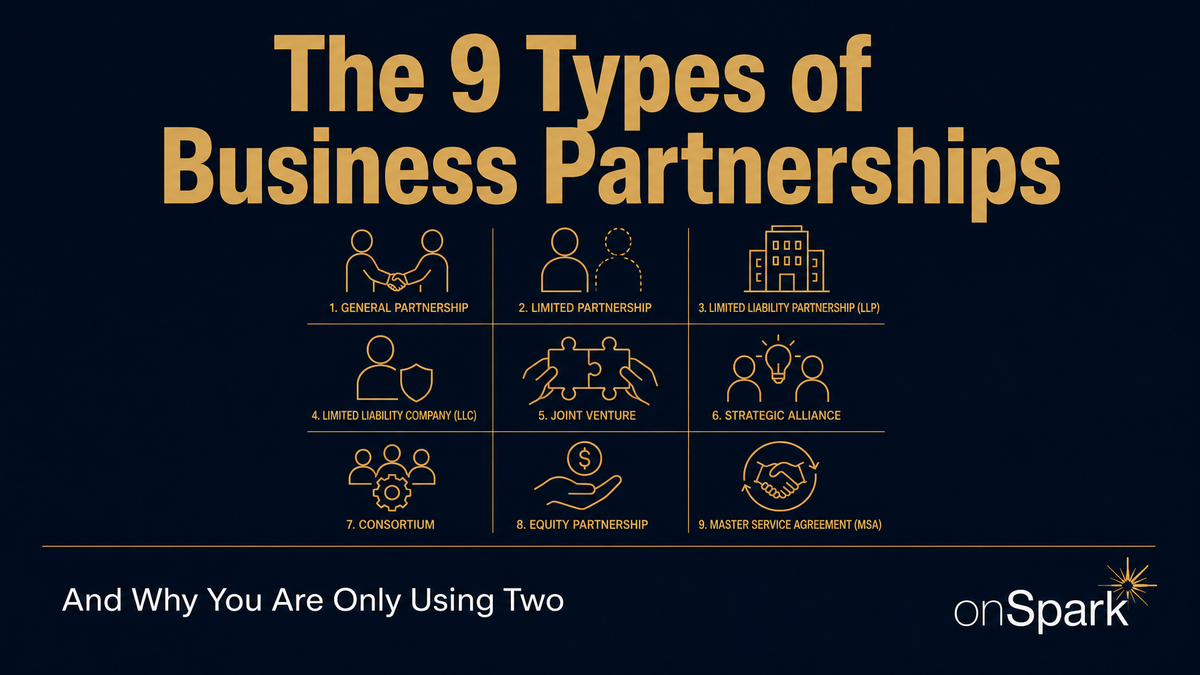
Most founders think about partnerships in one of two ways: "let's do a co-marketing post" or "let's build a referral program." That is not a partnership strategy. That is two tactics from a list of nine categories, which means most founders are leaving seven entire categories of revenue-generating partnerships completely untouched while their best-positioned competitors quietly scale using the full toolkit.
onSpark was built around a taxonomy of 9 distinct partnership categories. The platform has attributed over $2 billion in partnership revenue across 17,000+ professionals in-network, and the data is consistent: founders who actively pursue 4 or more of these categories grow faster, with more durable revenue, than those who limit themselves to whichever one feels most familiar.
1. Audience Growth Partnerships
Audience growth partnerships involve direct distribution agreements with complementary creators, brands, or publishers who share your target customer. Think newsletter cross-promotions, joint webinars, and co-hosted live events. The goal is to borrow a trusted audience to accelerate your own list growth. Prioritize this early stage, when your owned audience is small and paid acquisition costs are prohibitive.
2. Media Partnerships
Media partnerships are editorial relationships with publications, journalists, content platforms, and digital media brands. This includes contributed articles, expert commentary placements, and co-produced research reports. Prioritize this when you need to establish category authority or are entering a market where trust is the primary purchase barrier.
3. Speaking Opportunities
Speaking partnerships involve relationships with event organizers, conference producers, and summit hosts who position you in front of pre-qualified audiences. The partnership component is the reciprocal relationship: event access in exchange for content, promotion, or affiliate arrangements. Speaking in front of 300 qualified founders converts at a fundamentally different rate than running ads to cold traffic.
4. Podcast Sponsorships and Partnerships
Podcast partnerships range from paid sponsorships to full editorial integrations where the host becomes a genuine advocate. A host-read endorsement from someone who has used your platform outperforms a scripted mid-roll at roughly 4:1 in conversion rate terms. Identify the 5-10 podcasts your best customers listen to and pursue those relationships directly rather than using podcast ad networks.
5. Affiliate Sales Partnerships
Affiliate partnerships are performance-based distribution agreements where partners earn a revenue share for each referred customer. This is the most transactionally clean partnership model: partners are paid on results, not on effort. Prioritize this when your product has a defined price point, sufficient margin to support commission, and a buying journey short enough for affiliates to credibly own.
6. Creator Networks
Creator network partnerships involve structured relationships with individual content creators who embed your brand into their content ecosystem. The best creator partnerships involve co-created products, exclusive offers, or genuine community-building rather than sponsored posts. Prioritize this when social proof from trusted voices is a key conversion lever.
7. Technology Integrations
Technology integration partnerships are co-development or API-level relationships with complementary software platforms. When done well, a native integration makes your product stickier, surfaces you to the partner's user base, and creates mutual switching cost that benefits both parties. Prioritize this when your product is genuinely enhanced by connection to another tool your customers already use.
8. Investor Groups
Investor group partnerships involve relationships with angel networks, family offices, venture funds, and investment communities whose portfolio companies or LPs represent your target customer or distribution channel. Prioritize this when your offer serves a founder or executive audience and when investor community endorsement functions as a trust accelerant.
9. Data and Content Partnerships
Data and content partnerships involve structured exchanges of proprietary research, audience data, or content production between complementary organizations. This includes joint industry reports, co-produced white papers, benchmarking studies, and data licensing arrangements. Prioritize this when your business generates proprietary data or when you need to establish category authority in a new vertical.
The One Your Competitors Are Already Using
The answer varies by industry, but the pattern is consistent: the fastest-growing companies in any given category are typically dominating one category their peers are ignoring, usually creator networks or technology integrations, while maintaining baseline activity in three or four others.
The competitive question is not which category is universally best. It is which of these nine you have never seriously pursued, and whether that gap is strategic or simply a blind spot. Most of the time, it is a blind spot.