The Deal Expired While the Company Kept Growing
Co-founder breakups and failed strategic alliances get narrated as vision problems. Most are founding deals that expired in silence while the company kept growing and nobody scheduled a renewal.
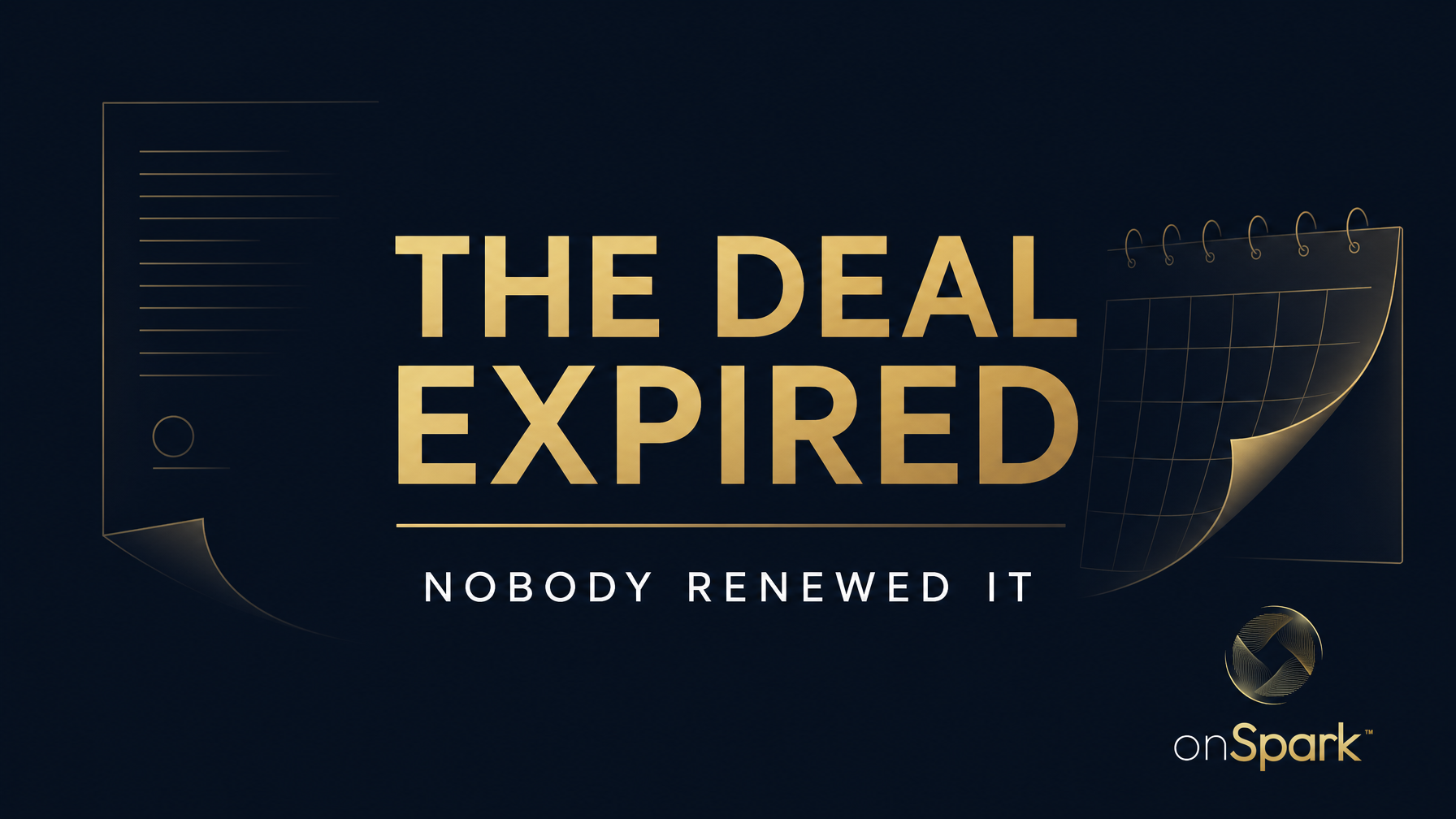
Most co-founder breakups get narrated as a vision problem, when the real failure was a founding deal that quietly went out of date and never received a renewal date on the calendar. The official story arrives polished. Different directions. Philosophical distance. Strategy that no longer fit. Inc just published a clean autopsy of that pattern, and the mechanism underneath it is almost boring in its predictability. Two people designed a division of labor for a company that barely existed. The organism grew into something else. The agreement that governed who they were to each other stayed frozen at the version written when they could still grab problems by hand.
That same freeze shows up far beyond the founding pair. Strategic partners, channel operators, and revenue-sharing alliances all inherit an original bargain that was perfect for the company that signed it and increasingly absurd for the company that is now living inside it. Founders treat the first arrangement as sacred architecture. Markets treat the first arrangement as a temporary hypothesis. The gap between those two attitudes is where resentment ferments until someone finally calls it misalignment, which is a polite word for a contract that expired in silence.
The company changed. The bargain did not.
At ten people, the partner who owns sales is still on the phone. At a hundred, that same function is a team, a compensation philosophy, a pipeline review, and a founder whose real job is to hire the person who does what the founder used to do and then leave the room. The Inc piece lands on this with precision. The fracture rarely begins as a disagreement about the future. It begins as a feeling that one side is holding too tight while the other is going quietly obsolete, and neither person wants to say the sentence that would force a redesign.
Private equity is learning a parallel lesson in public this week. CFA Institute's Enterprising Investor just walked through six risks in buy-and-build structures where founders stay in operations after a partial sale. The spreadsheet assumes alignment on shared costs, capital allocation, and the moment intervention becomes legitimate. The relationship assumes goodwill will cover what the covenant never named. When the holding company builds infrastructure the founder never would have funded alone, every invoice becomes a renegotiation of fairness that the original deal never priced. Staged-control options with soft milestones turn into arguments the moment control is supposed to flip. The option was never an option. It was a deferred fight dressed as a valuation bridge.
Founders building external partnerships recreate the same structure without noticing the rhyme. They lock exclusivity, revenue split, and brand language in a season when the product still needed a story more than it needed a forecast. Eighteen months later the product has a real number, the partner has a real quota pressure, and the original split still treats both sides as if the company is pre-product-market fit. Nobody scheduled the conversation that would have rewritten the economics while the relationship still had enough goodwill to survive honesty. The deal expired. The meetings continued.
What founders do instead of renewing
The observable behavior is specific. A founder senses the friction in week six of a quarter that should have been easy. They reframe it as temporary. They add context about the partner's internal reorg, the market, the timing. They extend runway in the form of softer language, extra headcount on the joint account list, or a QBR that celebrates process while the closed-won column stays empty. Each of those moves is a quiet refusal to put the original bargain back on the table as a living document.
The cost compounds with precision. The partner learns that discomfort produces accommodation rather than redesign. Internal operators learn that partnership work is where standards go to become stories. Better counterparties, the ones who would have demanded a dated kill clause and a public scoreboard in month one, sort themselves away from a process that rewards loyalty to an outdated arrangement over loyalty to the current economics. Six months of calendar get spent defending a structure that both sides privately know no longer matches the company that is paying for it.
Co-founder pairs do this to each other. Channel partners do this to each other. Buy-and-build platforms do this across entire portfolios. The pattern is identical. An agreement that was once accurate becomes a museum piece, and the museum piece keeps governing the operating reality because rewriting it would require admitting that the original design had a shelf life. Founders would rather live inside a polite fiction than schedule the renewal conversation while the fiction is still cheap to end.
Renewal is the work
The founders who keep partnerships alive through scale treat the first deal as a version number. They put a calendar date on the next redesign the same week they sign. They renegotiate roles when the company crosses a headcount threshold, a revenue threshold, or a channel concentration threshold, not when resentment has already chosen the narrative. They write intervention triggers the way PE lawyers write financial covenants, with measurement dates and accounting policies, because soft language is how options become courtrooms.
That discipline applies to every strategic relationship that carries revenue or reputation. Selection systems that keep fit and joint economics legible, including operators who use tools like onSpark AI before a relationship outgrows its paperwork, only matter if the company is willing to treat the live agreement as temporary by design. A partnership that cannot survive a scheduled rewrite was never a partnership. It was a first draft that both sides agreed to pretend was final.
The market will keep producing elegant stories about vision drift and philosophical distance. The underlying failure is simpler and harder to face. The company grew. The people inside the deal changed jobs without changing the deal. Nobody put a renewal on the calendar. By the time the resentment was loud enough to force a conversation, the conversation had already become an exit. The founders who win the next cycle will treat every partnership agreement as a living instrument with an expiration date written in ink, and they will renew it on purpose while both sides still have something left to protect.