The Investment Nobody Measures
69% of companies are increasing partnership investment this year. Only 42% can measure what those partnerships produce. The gap is not a tooling problem. It is a belief problem that has been structural since the first conversation.
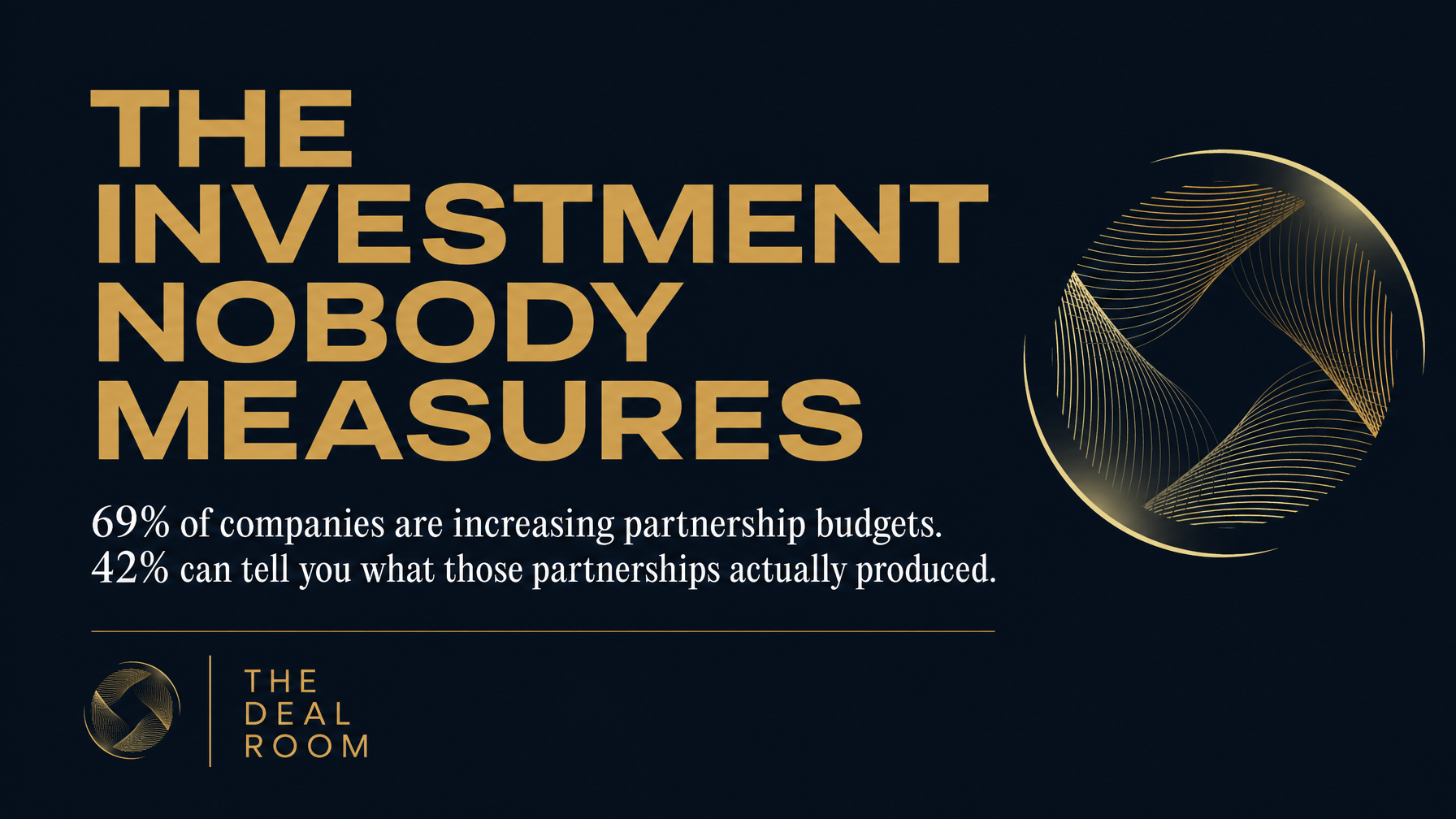
Sixty-nine percent of companies plan to increase their investment in partnerships this year, and fewer than half of them can tell you what those partnerships are actually producing. The State of Partnerships in GTM 2026, published this year by PartnerStack, surfaced that gap with a specific number: only 42 percent of companies use multi-touch attribution across their full funnel. The instinct in most boardrooms when this data circulates is to treat it as a tooling problem, a CRM gap, a missing attribution layer that the right software will eventually close. That instinct is wrong. The measurement gap in partnerships is a belief problem, and it has been structural since the first conversation.
The Belief That Replaces the Evidence
Founders who increase partnership investment without a measurement framework are not operating carelessly, they are operating from a framework that predates every revenue metric they have ever used. A strong first meeting becomes evidence of alignment. A co-marketing campaign becomes evidence of momentum. A joint announcement at a conference becomes evidence that the relationship is producing something. These are not measurements, they are signals that the founder has decided to interpret as confirmation, because the alternative requires naming something that the relationship is not yet built to survive.
The cost of that belief is not visible in the month it forms. It surfaces six to nine months later, when the founder attempts to assess the partnership's contribution and realizes that every piece of data they have is activity data: meetings held, content produced, introductions made, none of which translates cleanly into revenue impact. At that point, the conversation with the partner becomes delicate in a very specific way. The founder cannot challenge the partnership's results without challenging the relationship itself, because the relationship has become the only currency on the table. Every month that passed without shared evidence became a month of mutual performance that neither party agreed to examine.
Only 42 percent of companies with active partnerships use multi-touch attribution across their full funnel. The other 58 percent are managing relationships they cannot evaluate, which means they cannot exit them cleanly, cannot renegotiate them on evidence, and cannot build the next one more precisely. They are, with increasing budgets and increasing public commitments, protecting something they have never actually measured.
What Investment Without Measurement Produces
When a founder increases partnership investment without a measurement framework, what they are actually doing is deepening the relational cost of eventual accountability. Every quarter that passes without shared data becomes a quarter of mutual performance that neither party has agreed to examine. The partnership grows in budget and visibility, in co-marketing and shared content, in the number of people inside each organization who have been told it is going well. The public record of success expands at exactly the rate that the private record of evidence fails to form.
This is why the partnerships that collapse most publicly are almost always the ones that received the most investment. The founder who bet the most on a relationship is the last one to build a framework that could question it, because the framework would have to live inside the same account where the confidence already does. The TBR research published this year made the observation directly in its 2026 alliances predictions: multiparty alliances require shared understanding of commercial models, and the human component remains the most significant roadblock, not the technology stack, not the attribution software, but the humans who have to agree, before anything is signed, on what evidence of success will look like and who holds the obligation to produce it.
The gap between 69 percent and 42 percent is not a technology gap. It is the distance between the moment a founder decides to invest in a partnership and the moment they decide to hold themselves accountable for what it produces. Most founders never close that distance, because closing it would require admitting, before the relationship has built any momentum, that confidence is not a substitute for criteria.
The Number That Changes the Conversation
The practical difference between a partnership that holds and one that quietly dissolves is almost never the quality of the relationship. It is whether both parties agreed, before the first deliverable shipped, on a single north-star metric that the relationship had to meet or renegotiate. That number creates a structure that the relationship has to produce for, and a structure that both parties can inspect without it reading as an accusation.
Without it, the partnership is managed entirely on relational goodwill, and goodwill is the first thing that disappears when performance is flat. Founders who are increasing partnership budgets this year without a defined success metric are making a bet that the relationship itself will surface the truth when something goes wrong. The data from every prior year suggests it will not. Relationships protect the version of truth that the relationship can survive, and by the time a founder realizes the partnership has produced nothing, they have spent twelve months building a public body of evidence that it has.
The platform that forces this conversation before the budget moves adds the one structure that makes the investment worth making. onSpark's matching framework is built specifically around defining success criteria before introduction, which is the only moment when both parties have the leverage and the clarity to agree on what accountability looks like. The measurement conversation is easier before the relationship forms than it is at month nine, when the same ask reads as distrust because that is exactly what it has become.
The 27-point gap between how many companies are increasing partnership investment and how many are measuring it is not going to close on its own. It closes when a founder decides that evidence is more durable than confidence, which is harder than it sounds because confidence, right up until the quarter the numbers are due, feels exactly like a plan.