The Partnership Surge Is Creating a Trust Deficit
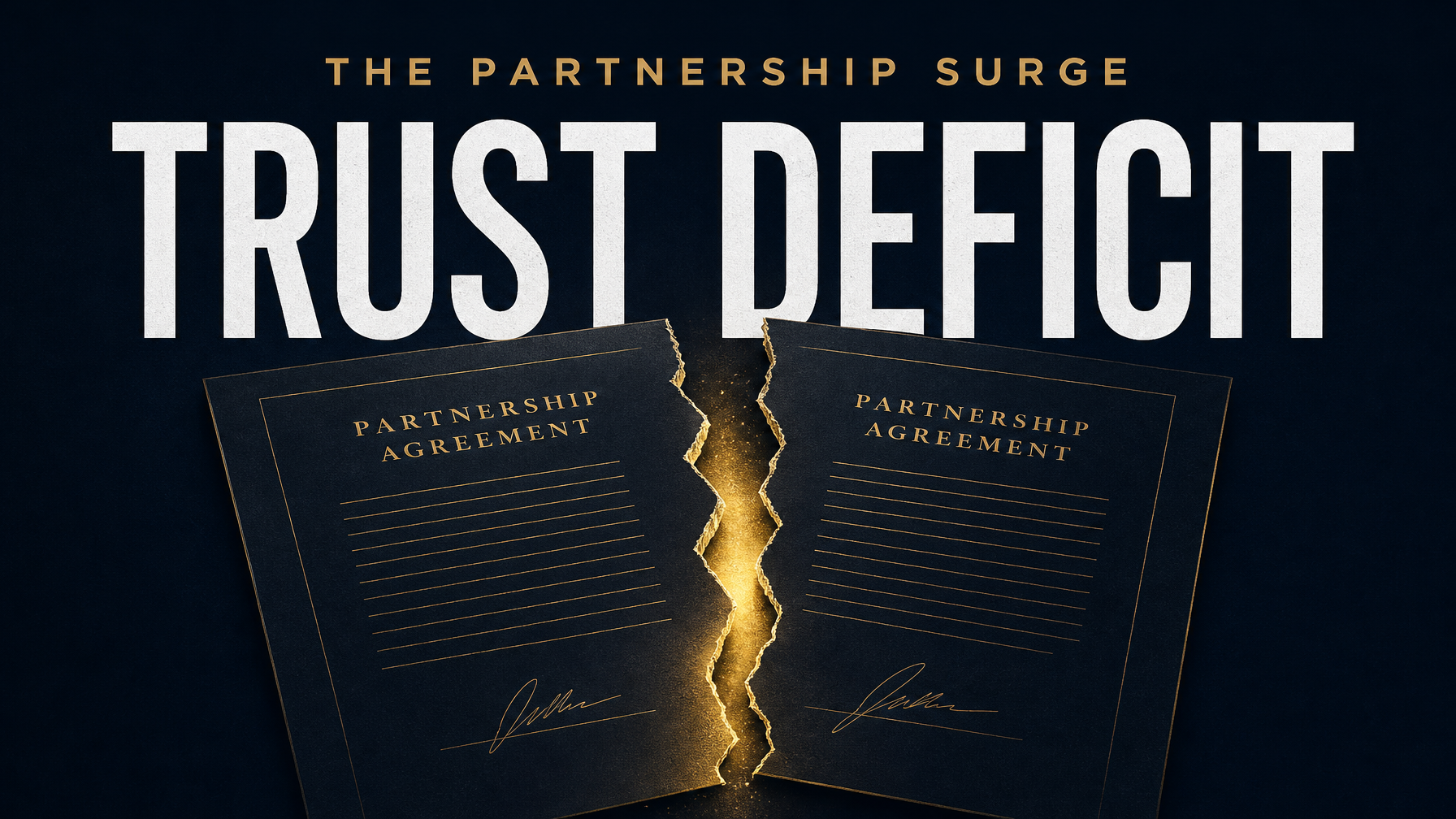
Most founders signed more partnership agreements in the first half of 2026 than they did in all of 2025, and they did less due diligence on every single one of them.
The numbers tell a clean story if you know how to read them. JPMorgan's 2026 Business Leaders Outlook puts 76 percent of innovation economy respondents in the bucket of actively planning strategic partnerships or investments this year, compared to 41 percent of middle market companies. That is not incremental growth. That is a stampede toward a structure most founders have never been taught to operate. PwC's mid-year M&A outlook names strategic partnerships as a channel for capital deployment that is outpacing traditional M&A. Every signal says the same thing. Partnerships are the deal type of the moment, and everyone wants to be seen doing them.
There is a gap forming between the speed at which partnerships are being signed and the infrastructure required to make them work, and that gap is where trust goes to die.
The velocity problem nobody is naming
We have built an entire culture around partnership announcements. The LinkedIn post goes up the day the agreement is signed. The joint press release drops before the operating plan is finished. Founders collect logos the way they used to collect speaking slots, as social proof that they are growing, that they are connected, that they are chosen. What is invisible in every announcement is the quality of the diligence that preceded it, because almost no one is doing any.
The average founder in 2026 will spend more time evaluating a project management tool than they spend evaluating a strategic partner who will have access to their customers, their reputation, and their revenue. The tool gets a trial period, a feature comparison spreadsheet, a team vote. The partner gets a good feeling in a meeting and a handshake over coffee. I have watched this pattern repeat for years across thousands of partnerships, and the velocity of the current market has made it worse, not better.
When Skadden published its June guidance on managing the unique risks of buying a founder-led brand, the opening premise was that founder-led deals carry specific risks that traditional deal structures do not capture. What applies to acquisitions applies more acutely to partnerships, because a partnership has even fewer contractual guardrails than an acquisition. You are not buying the company. You are tying your reputation to a person you barely know and calling it strategy.
The founders who are winning in this environment are not the ones signing the most deals. They are the ones with a filtering mechanism that survived contact with urgency.
Trust is not a feeling, it is a dataset
Most founders use the word trust to describe something that is actually chemistry. They felt comfortable in the room. The conversation was easy. The other person's energy matched theirs. They call this trust because it sounds responsible, but chemistry is your nervous system recognizing a pattern it already knows how to survive, not evidence that the other party will behave consistently when incentives shift.
Real trust in a partnership context is a dataset built from low-stakes behavioral observations over time. Did this person do what they said they would do when there was no financial incentive to do it. Did they name the hard thing in the room or did they route around it. Did they follow up when the follow up was boring. Did they tell you no when yes would have been easier for them and worse for you.
Every one of those questions requires time and deliberate observation. The current market is specifically designed to deprive you of both. When capital is flowing into strategic partnerships at record pace, the pressure to move quickly is immense. Your investors want to see ecosystem plays. Your board wants to see distribution leverage. Your own ambition wants to see the logo on the slide that proves you are scaling.
The cost of skipping the trust dataset is not that the partnership fails loudly. The cost is that it fails slowly, in a way that extracts quarters of your attention before you finally name what was true from the beginning. CRV published a piece in February on what it takes to build a partnership that lasts, and one of their sharper observations was that bad stories about previous co-founders or investors signal relationship problems that founders consistently underweight. We ask about successes. We should be asking about how someone exited the last thing they said was a partnership.
What to build instead
If you are going to participate in the partnership wave of 2026, which you probably should, you need a trust infrastructure that operates independently of your enthusiasm.
The first piece is a time gate. No strategic partnership should move from introduction to signed agreement in fewer than 30 days. That sounds like a long time when your competitor just announced their deal with the brand you wanted. It is nothing compared to the 18 months you will spend unwinding a misaligned agreement that you rushed into because the market told you speed was the metric.
The second piece is a behavioral audit, not a resume audit. Call three people who have partnered with this person before, and ask one specific question, not whether they would work with them again but how that person behaved when the deal got difficult. Everyone will say yes to a second deal with a warm introduction. Very few people will give you a clean answer on the difficulty question without pausing, and the pause is the data.
The third piece is an operating agreement that names the conflict process before there is a conflict. Most partnership agreements have a revenue split but no dispute clause, because both sides assume goodwill will cover what the contract does not. The absence of a conflict process is not trust. It is unpriced risk, and it compounds silently until the first moment someone needs it and it is not there.
Platforms that systematize partnership vetting and operating infrastructure exist precisely because individual willpower does not survive market urgency. When onSpark AI maps a founder against 17,000 professionals with behavioral data instead of just introductions, the point is not to slow you down, it is to give you a reason not to speed past the only questions that actually predict whether this partnership will produce revenue or consume it.
The partnership surge of 2026 will produce an outsized number of failures in the second half of the year, not because partnerships are a bad strategy but because most founders are executing a volume strategy inside a structure that rewards precision. The market will not correct quickly enough to save you from your own pipeline. The only thing that will is a standard for trust that holds when urgency tells you to waive it.