The Urgency Problem: Why Survival Mode Produces the Wrong Partners
59% of founders are worried their company won't survive the next 12 months. The ones who react by pursuing a partnership are making the most consequential decision at the worst possible moment.
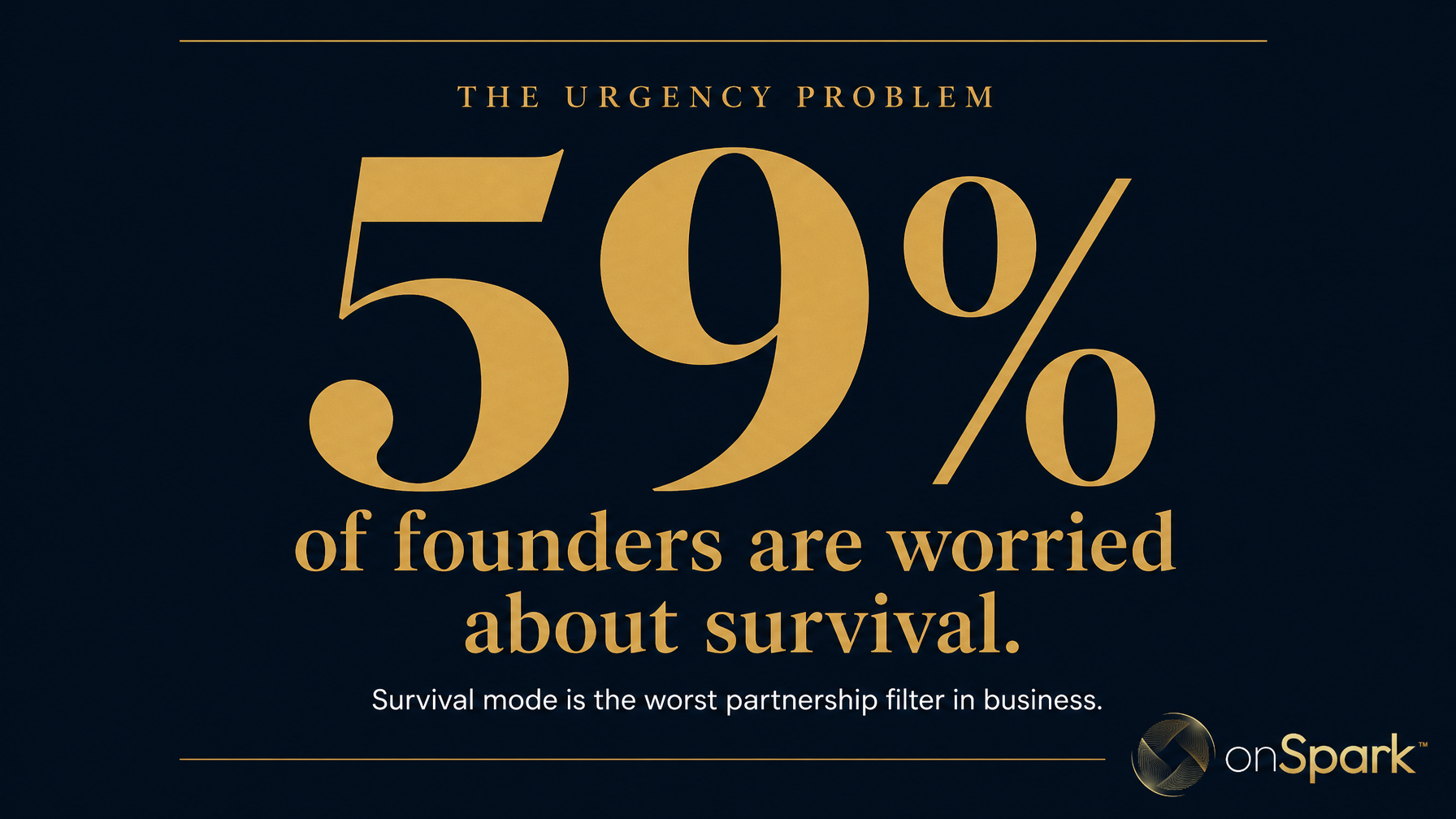
A survey released by Wilbur Labs in April 2026, drawing on responses from 200 startup founders, found that 59 percent of them are worried their company will not survive the next twelve months, and somewhere inside that statistic is the setup for a partnership disaster that none of those founders are currently anticipating.
The number itself has been circulating in founder communities and investor newsletters since the report dropped. Most of the commentary treats it as a data point about market uncertainty, about AI disruption, about the difficulty of surviving a capital environment that rewards fewer bets with larger checks. Those readings are accurate. They are also missing the more consequential implication, which is what 59 percent of founders do when they believe the clock is running.
They go looking for a partner.
This is the natural human response to existential pressure. When the runway is shortening and the pipeline is thin and the investor who seemed warm has gone quiet, the founder reaches for the only lever that feels both fast and legitimate: a strategic partnership. Someone who can bring distribution, or clients, or credibility, or capital-adjacent resources that close the gap between where the company is and where it needs to be in six months. The logic feels sound. Partnerships can do all of those things. The problem is not the destination. It is the selection process that happens on the way there.
What Urgency Does to the Evaluation
A founder operating from a position of options asks a different set of questions than a founder operating from a position of urgency. The founder with options asks whether the potential partner has the right operational cadence, whether their incentive structure is aligned across a three-year horizon, whether their communication patterns under pressure reveal someone you can trust with your pipeline or your clients or your name in a market where you are still building it. These are slow questions. They require multiple conversations, real scenarios, and enough patience to let the relationship demonstrate itself before you commit to it structurally.
The founder who is worried about surviving the next twelve months asks one question, and it is not one of those. The question is: will this person say yes, and will they say yes soon enough to matter. Every other variable subordinates to that one. Chemistry reads as alignment. Speed reads as enthusiasm. A signed agreement reads as the problem being solved.
This is not a failure of judgment. It is what urgency does to cognitive hierarchy. The variables that matter most for long-term structural fit require the most time to evaluate, which means they are exactly the variables that get compressed when time is the primary constraint. The founder who signs in month two of an existential pressure cycle has selected on the one criterion that survival mode makes legible, and built a partnership on top of a foundation that was never evaluated.
The Wilbur Labs report also found that 87 percent of founders described building a company as lonelier than they anticipated. That isolation compounds the urgency problem in a specific way. Founders who are both scared and isolated are not running a selection process. They are running a relief process. The partner who shows up with warmth and a term sheet is solving two problems at once, and the founder's nervous system is counting both solutions as evidence of fit. Neither warmth nor speed is evidence of fit. They are evidence that someone wants the deal.
The Partner Who Moves Fast on a Distressed Founder
There is a version of this story where the partner who closes quickly is simply efficient, decisive, and confident in the opportunity. That version exists. It is also the version that every partner who wants structural leverage tells, because it is indistinguishable from the outside at the moment of signing.
A partner who understands that a founder is in survival mode and moves quickly to close that founder has captured something. They have captured a counterparty who has not had time to compare alternatives, who has not had the leverage to negotiate terms from a position of strength, and who has not had the space to evaluate what this partnership looks like when the growth stops or the market shifts or the original thesis turns out to be wrong. The founder who is scared and isolated and grateful for the yes is not positioned to catch any of that. They are positioned to be grateful, and gratitude is an unreliable filter.
This is how partnerships get built at the wrong moment, with the wrong structural terms, in the wrong direction. The agreement is written at the founder's lowest point, which means the partner's leverage is baked into the document from the first draft. Twelve months later, when the founder has stabilized and would now evaluate differently, the terms are set and the cost of renegotiation is reputational. The conversation never happens, because starting it means admitting the original decision was made under duress, and most founders would rather carry the weight of a bad structure than make that admission publicly.
The Wilbur Labs report found that 42 percent of founders wish they had pivoted their business model sooner. Partnerships have the same problem, with an important additional cost: you cannot pivot a partnership without involving someone who benefited from the original terms. The drag is relational and structural simultaneously, and it compounds faster than a product problem does.
The Only Real Answer Is Timing
The counterintuitive truth about partnerships is that the best ones are built by founders who did not need them when they found them. The founder who already has revenue, already has clients, and already has some version of a working model is negotiating from a position where declining is a real option. Declining is the only lever that produces honest terms. When you cannot say no, the counterparty already knows your position, and the agreement reflects it.
This means that the infrastructure for partnership selection, the criteria, the process, the pipeline of prospective partners, needs to be built before the urgency arrives. A founder who builds that infrastructure in month four of a comfortable quarter is building something entirely different from the founder who reaches for a partner in month three of a survival quarter. Same activity. Different results. Different leverage. Different documents.
The 59 percent of founders who are worried about their business surviving the next twelve months are not looking for a thought leadership argument about selection criteria. They are looking for a yes. That is understandable, and it is also the most important moment to slow down, because the partner they close in that state is not the partner they would have chosen with options. onSpark was built around exactly this premise: that founders who build partnership pipeline before they need it are the ones who negotiate from a position of fit rather than relief. The founders who wait until the urgency arrives hand the selection process to the clock, and the clock does not know the difference between a good partner and a fast one.
The partnership market in 2026 is full of people willing to move quickly on a founder who is scared. Not all of them are wrong partners. But the ones who are wrong look identical to the ones who are right, at the moment when it matters most to tell them apart. The only way to tell the difference is time, and urgency is the variable that eliminates it.