The Year Everyone Invested More in Partnerships and Still Could Not Measure Them
69% of companies are increasing partnership investment in 2026. Fewer than half can attribute what those partnerships produce. That gap is not new — it is the exact shape of how founders have always approached partnerships.
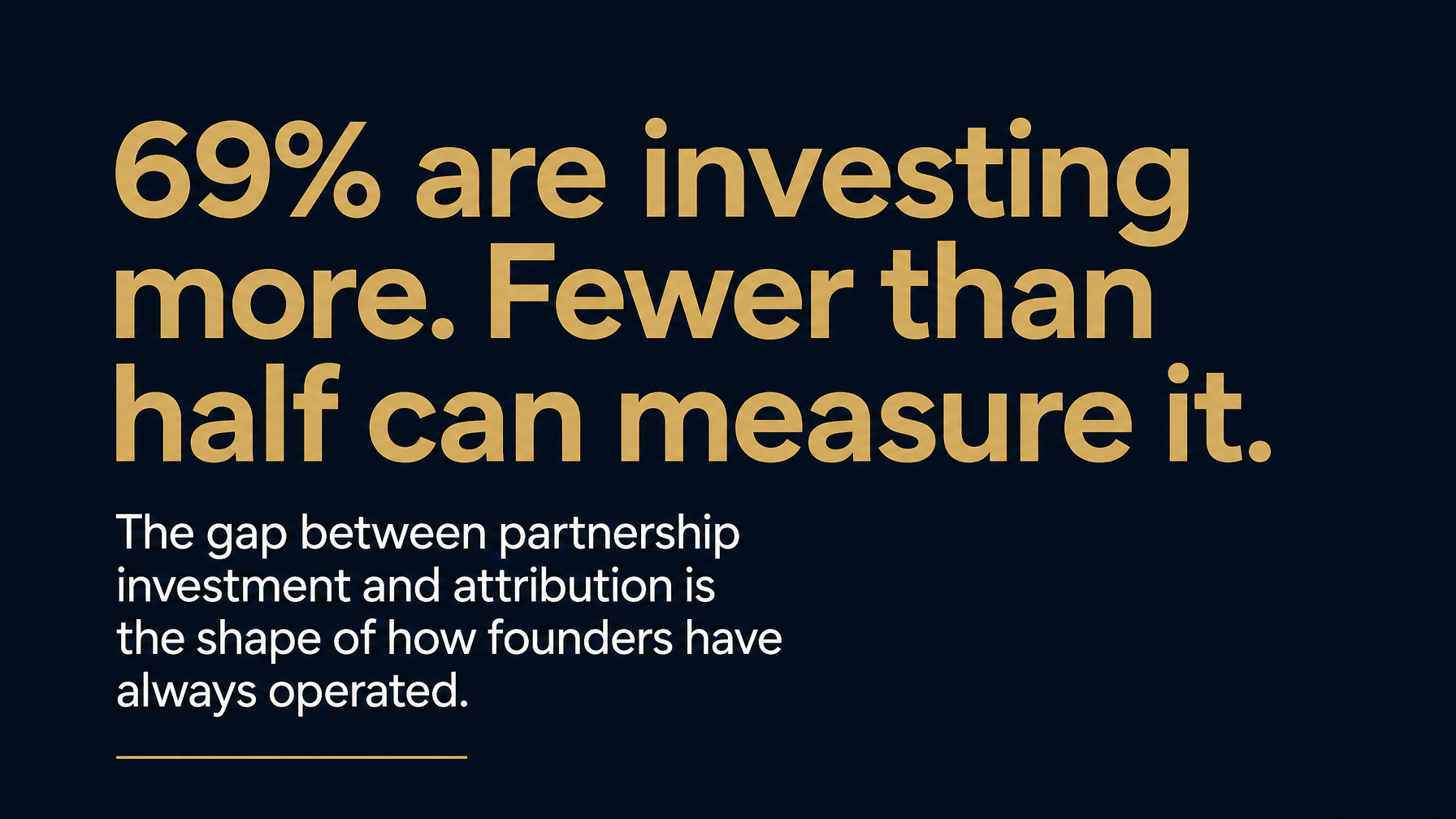
Sixty-nine percent of companies plan to increase their partnership investment in 2026, and fewer than half have multi-touch attribution in place across their funnel. That gap, documented in PartnerStack's State of Partnerships in GTM report released this year, is the most accurate summary of how founders have always treated partnerships: spend before you can read, then spend more.
Partnership investment increasing at record rates is not the headline. The headline is that the infrastructure to understand what those partnerships produce is absent at the same record rate. Founders are committing more budget, more relationship capital, and more organizational attention to partnerships than at any point in the last decade, and most of them will reach Q4 without a single clean data point about what those partnerships actually contributed to revenue.
This is not a technology problem. The attribution tools exist. The CRM integrations exist. The reporting frameworks exist. What does not exist, in most partnership programs, is the decision to build measurement infrastructure before the relationship gets moving, because measurement feels like it can wait, and the relationship feels like it cannot.
The thing that gets built first is the thing that gets optimized
The reason 70% of business partnerships fail within five years, a figure circulating through nearly every business publication this spring, is not primarily about misaligned values or communication breakdown, though those are real. The structural reason partnerships fail is that founders build the relationship before they build the system, and then they manage the relationship while the system gap quietly compounds into a revenue problem they cannot diagnose.
A founder who cannot attribute partnership-sourced pipeline cannot know whether to invest more in that partnership, renegotiate it, or exit it. They can only feel. And feeling is not a bad thing in the early stages of a relationship, but it is a catastrophic decision-making framework for a revenue motion you have committed budget to at scale.
What actually happens is predictable. A partnership gets announced, a co-marketing initiative launches, referrals start moving, and for the first ninety days the founders call it working because things feel active. Then the quarter closes and the numbers are unclear. The partnership-sourced deals are mixed in with direct pipeline, attribution is murky, the partner relationship is warm, and nobody wants to have the conversation that the data would force. So the next quarter begins with the same motion, the same warmth, and the same measurement gap, and the investment continues because the relationship makes it feel reasonable to continue.
That is not a partnership. That is an expensive friendship with commercial framing.
What you cannot measure, you cannot renegotiate
The cost of the measurement gap is not the quarter where you cannot produce the number. The cost is the twelve months that follow, during which the founder increases investment because the partnership feels productive, without the data that would tell them whether to double down or redirect. By the time the partnership fails visibly, the founder has spent the better part of a year optimizing a motion they were never actually able to read.
When founders describe failed partnerships, they almost always attribute the failure to the partner. The partner was not committed. The partner's audience was not the right fit. The partner's sales team did not prioritize the deal. These are real observations, but they are observations made at the end of a process that failed much earlier, at the point where the founder chose to invest without building the infrastructure to know whether the investment was producing anything.
The PartnerStack data makes this explicit. With only 42% of companies using multi-touch attribution across their funnel, the majority of partnership programs in 2026 are being managed on feel, on relationship warmth, and on the mutual optimism of two parties who want the collaboration to work. That is an understandable starting point. It is not a viable operating system for a strategic revenue channel.
Founders who build the measurement architecture before the partnership goes live have a different set of decisions available to them. They can see when a partnership is generating pipeline but losing it at the proposal stage, which is a product or pricing problem, not a partner problem. They can see when a partner's referrals are converting at twice the rate of direct outbound, which tells them something about audience fit that no amount of co-marketing discussion would surface. They can have a concrete, data-grounded conversation with a partner about what is working and what needs to change, rather than a diplomatic conversation about intentions and effort.
That conversation, the one grounded in shared, visible data, is the one that separates partnerships that compound over years from partnerships that plateau at month four and slowly dissolve over the following eight.
The investment is not the problem
Sixty-nine percent of companies increasing partnership investment this year is a reasonable response to a market where organic reach is harder, sales cycles are longer, and warm referrals convert at rates that cold outbound cannot match. Strategic partnerships, built correctly, are one of the few growth mechanisms that compound rather than degrade over time. The investment thesis is sound.
The problem is not the investment level. The problem is that most companies are scaling the activity while skipping the infrastructure, which means they are scaling a motion they cannot optimize, at a budget they cannot justify with data, in a channel they will eventually blame rather than architect correctly.
The founders who separate themselves in the next cycle are the ones who decided, before the first partner meeting, that measurement was not a phase two problem. They built the attribution model first, defined what a productive partnership looks like in concrete terms before committing to the relationship, and treated the inability to measure as a structural disqualifier rather than a detail to sort out later. Platforms like onSpark exist precisely to help founders build partnership programs structured for output from day one, rather than retrofitted for accountability when the numbers stop making sense.
The partnerships that survive five years are the ones that could be read from the beginning. Everything else is a bet that something good is happening and a hope that the numbers will eventually confirm it.